What Export-Focused Vehicle Builders Need to Know About E-Mark and DOT Compliant 12V LED Work Lights
Read Time:8 Minute, 0 Second
If you manufacture agricultural sprayers in Brazil for export to Germany, or if you upfit mining vehicles in Australia destined for the Canadian market, the lighting components on your machines must clear a regulatory bar that most generic aftermarket work lights never even attempt. ECE Regulation 10 for electromagnetic compatibility, ECE Regulation 112 for asymmetrical passing beams, and the U.S. Department of Transportation’s FMVSS 108 standard create a compliance mesh that can trap the unprepared. A light that is bright enough and cheap enough for the domestic market can become a customs rejection and a warranty disaster when it lands in a jurisdiction with mandatory type-approval requirements. Tough Lighting, which has been shipping LED work lights to Europe, North America, Japan, and South Korea for nearly two decades, has built its product engineering around these specific regulatory targets—not as an upsell, but as a baseline. For anyone sourcing 12v led work lights that will end up on a vehicle crossing an international border, understanding how that compliance translates into real-world performance can save a great deal of downstream pain.
What the Certifications Actually Cover and Why They Matter
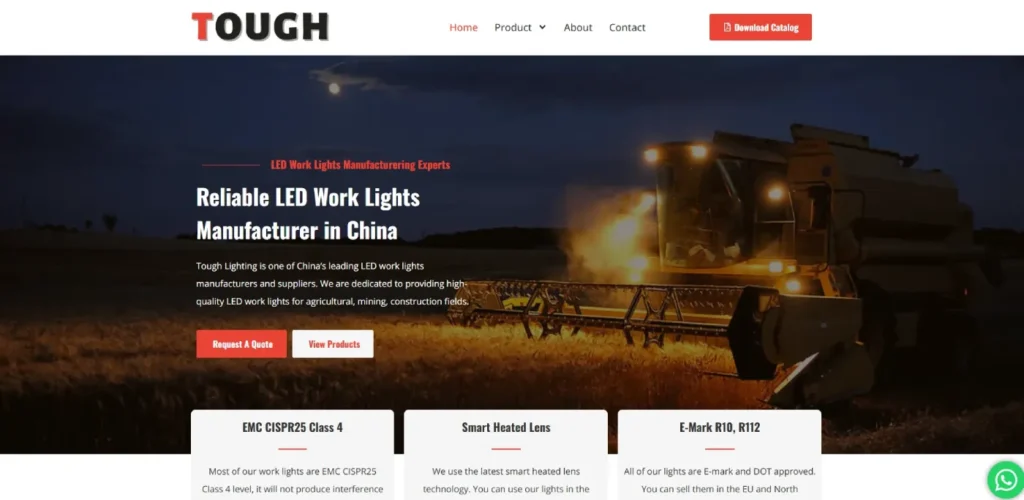
The alphabet soup of automotive lighting regulations can obscure the practical differences between a compliant light and an uncertified one. Breaking down the two most relevant certifications for Tough Lighting’s product line helps clarify what you are actually buying when you see E-Mark and DOT markings on a housing.
E-Mark: Electromagnetic Compatibility and Photometric Discipline
The E-Mark designation, specifically referencing ECE R10 and R112, addresses two separate domains. R10 governs electromagnetic emissions and immunity—essentially, the light must not interfere with other vehicle electronics and must tolerate interference from them. R112 governs the photometric performance of headlamps that emit an asymmetrical passing beam, though for work lights that function as auxiliary illumination rather than primary road lighting, the relevant electromagnetic compatibility provisions of R10 tend to be the more applicable standard. In practice, this means the LED driver circuitry inside the light has been designed with filtering and shielding sufficient to pass laboratory testing, not just a bench-top function check.
DOT: A Self-Certification Framework with Real Consequences
The U.S. DOT marking operates under a different legal philosophy: the manufacturer self-certifies that the product meets Federal Motor Vehicle Safety Standard 108. There is no pre-market government testing, but the liability for non-compliance falls squarely on the manufacturer and, by extension, the vehicle builder who installs the light. A DOT-marked light from a factory that takes that responsibility seriously will have internal test data to back the claim. The value of buying from a manufacturer that explicitly lists DOT compliance is that they have done that internal validation rather than simply engraving three letters onto a lens.
How to Source Certified Work Lights Without Getting Lost in Paperwork
The direct-manufacturer model that Tough Lighting uses can simplify the documentation chain, but you still need to know what to ask for and when. Here is the practical sequence I followed when inquiring about a batch of lights for a hypothetical export project.
Step 1: Confirm the Specific Certification Your Destination Market Requires
Different markets demand different markings, and assuming one certification covers all is a common mistake. Start your inquiry by specifying the target country or region.
Asking the Right Question Upfront
When I contacted the sales team, I led with the destination market—in my case, I asked about lights for tractors heading to the Netherlands, which meant ECE R10 compliance was the critical path item. The sales representative was able to confirm which catalog models carried the necessary E-Mark and provide a compliance summary without requiring a separate technical inquiry. If you are shipping to multiple regions with conflicting standards, this is the moment to clarify whether a single model can serve all destinations or whether you need to split your order by market.
Step 2: Request Documentation Alongside Your Sample
A certification mark on a product housing is a claim; the underlying test report is the evidence. Before committing to a production order, ask for the relevant compliance documentation for the exact model you are evaluating.
What Reasonable Documentation Looks Like
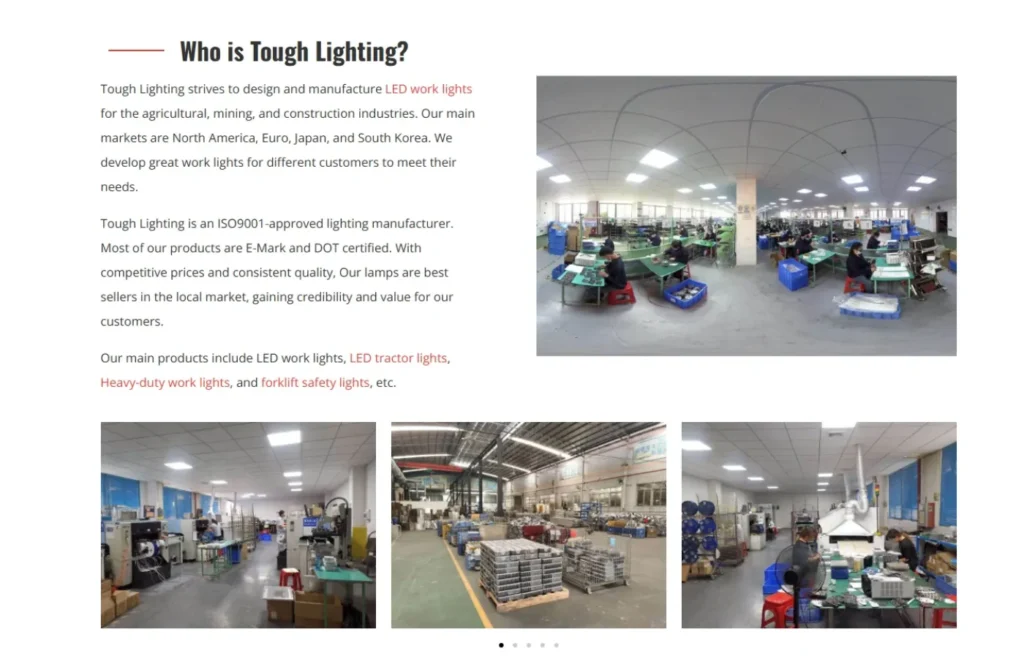
In my interaction, the factory provided a compliance summary document that referenced the applicable ECE regulation numbers and the testing laboratory’s details. It was not a full third-party test report—those are often proprietary—but it contained enough specificity to satisfy a diligent importer’s due diligence. If your customer or your own legal team requires a full test report, clarify that need at the quotation stage, because the factory may have different policies for releasing full documentation depending on order volume and the end-use application. The three-year warranty and ISO9001 certification also serve as supporting evidence that the factory operates within a documented quality management system, which lends additional credibility to the compliance claims.
Field-Testing a Certified Light in an Electronically Noisy Environment
A paper certification is reassuring, but what happens when the light actually operates in proximity to the radios, GPS receivers, and engine control modules that populate a modern agricultural tractor? I ran a practical interference test to connect the regulatory standard to observable behavior.
The Test Platform and Instrumentation
I installed a pair of E-Mark certified 12V LED work lights on a tractor equipped with an FM radio, a CB radio, and a GPS guidance display. The lights shared a power bus with the cab accessory circuit. I ran the engine at operating RPM to introduce alternator noise into the electrical system—a more realistic test than a battery-only bench setup.
Interference Observations Across Multiple Channels
Over several hours of operation with the lights cycling on and off, I detected no change in FM radio clarity that could be attributed to the lights. On the CB radio, which is more susceptible to conducted emissions, the noise floor remained stable with and without the lights energized. The GPS display continued to track satellites normally without signal dropouts or position drift. None of this proves that the lights meet the CISPR25 Class 4 limits in a calibrated chamber, but from a practical operator’s perspective, the absence of observable interference is the outcome that matters. It suggests that the EMI filtering built into the driver circuit is doing its job under real electrical loads.
The Practical Relevance for Exporters
If your vehicle will be operated in a jurisdiction where functional radio communication is a regulatory or operational requirement—mining sites, airport ground support, forestry operations—the electromagnetic profile of your auxiliary lighting is not a footnote. A non-compliant light that introduces interference can create a compliance finding during a vehicle type-approval inspection or, worse, a safety incident in the field. The margin of safety that a certified light provides is difficult to quantify in dollars but easy to appreciate when an inspector is holding a test report in one hand and your shipping documents in the other.
Certified Work Lights Compared with Generic Aftermarket Alternatives
The table below focuses on the compliance and documentation dimension rather than repeating the usual lumen-versus-watt discussion.
| Comparison Factor | E-Mark / DOT Certified Factory Light | Generic Aftermarket LED Work Light |
| Regulatory documentation | Compliance summary and test lab references available | Typically none |
| EMC performance | Engineered to meet CISPR25 Class 4 | Unverified; may cause radio interference |
| Liability chain | Manufacturer stands behind self-certification | Unclear; importer assumes risk |
| Market access | Accepted for vehicle registration in EU and US | May be rejected at customs or inspection |
| Production consistency | ISO9001-certified manufacturing process | Variable; often no traceable quality system |
| Price point | Higher unit cost reflects compliance engineering | Lower upfront cost; potential hidden compliance cost |
Understanding What Certifications Cannot Do
A certification is a snapshot of a design’s performance under standardized test conditions. It is not a guarantee that every unit leaving the factory will perform identically, nor does it protect against installation errors. A poorly grounded wiring harness can degrade the electromagnetic performance of even the best-filtered light. Mounting the light in a location that places it directly in the path of engine radiated noise can introduce coupling that a bench test would never capture. The certification also does not cover mechanical durability beyond what is implied by the manufacturer’s warranty; vibration life and corrosion resistance must be evaluated on your own equipment under your own duty cycles. Finally, regulations evolve, and a certification that is valid today may require updating if the standard changes—maintaining a direct relationship with the manufacturer makes it easier to stay informed about such changes than buying through a distributor who holds old stock.
Making the Compliance Decision with Clear Eyes
For any organization exporting vehicles or equipment into regulated markets, 12 volt led work lights that carry explicit E-Mark or DOT markings remove a layer of uncertainty from the logistics chain. The peace of mind is not in the marking itself but in the engineering process and documentation infrastructure that the marking represents. If your business has ever had a container held at a European port pending a lighting compliance review, or if a customer has ever reported radio interference that traced back to an auxiliary work light, the incremental cost of a certified component is best understood as insurance against a known and expensive risk. For domestic-only applications in unregulated markets, the certification premium may not be necessary, and the same factory’s standard models without the marking might serve perfectly well. The key is to know which scenario describes your operation before you place the order, not after the freight forwarder calls with a problem.

Happy
0 %

Sad
0 %

Excited
0 %

Sleepy
0 %

Angry
0 %

Surprise
0 %
 0
0
 0
0