
Designing Reliable Sealed Connections for Industrial Equipment
Read Time:3 Minute, 8 Second
Reliable sealed connections are designed as complete interfaces, not selected from an ingress rating alone. The connector halves, cable jacket, rear seal, panel opening, gasket, coupling, and installation method all contribute to protection. If one element is mismatched or assembled incorrectly, moisture and contamination can reach the contacts even when the catalog part carries a strong rating. Industrial equipment teams should therefore define the real exposure before choosing a connector family.
Begin with the environment. Rain, condensation, dust, oil mist, high-pressure cleaning, temporary immersion, and outdoor sunlight create different risks. Record whether the connection will be protected by an enclosure, directly exposed, frequently disconnected, or cleaned while energized. Temperature cycling also matters because repeated expansion and contraction can affect seals and cable glands. A clear environmental profile gives suppliers enough information to recommend materials and sealing arrangements suited to the application.
Next, define electrical and signal requirements. Confirm current per contact, voltage, pin count, grounding, shielding, and whether circuits carry power, analog signals, sensor data, or industrial communications. Avoid assuming that all configurations within one shell size share the same ratings. Higher pin density can reduce spacing and change thermal behavior. For sensitive signals, evaluate contact resistance, shielding continuity, cable construction, and separation from nearby power conductors.
Mechanical retention deserves equal attention. Threaded couplings provide secure engagement but require space and correct tightening. Bayonet or push-pull designs may speed service but must still resist vibration and accidental release. Panel-mount parts need a controlled opening, gasket surface, panel thickness, and tightening method. Cable-end parts need proper strain relief so pulling or bending forces do not transfer directly to the contacts or rear seal.
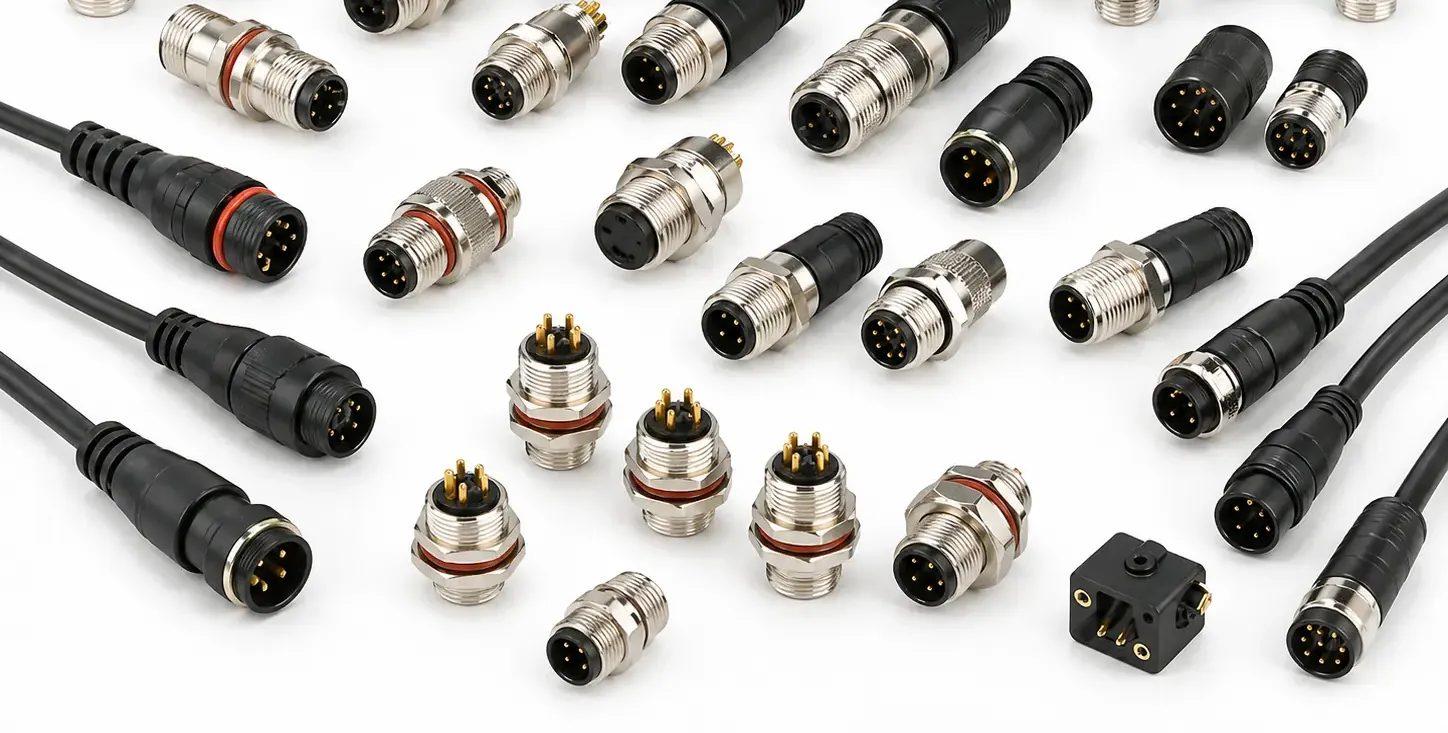
Cable compatibility is a frequent source of leakage. The outer diameter must fall within the specified sealing range, and the jacket material should tolerate the expected temperature, chemicals, flexing, and sunlight. If the cable is too small, the gland may not compress enough; if it is too large, assembly can damage the seal. Buyers reviewing waterproof connectors should match the selected cable and termination process to the exact connector configuration.
Assembly procedures should be simple, documented, and verifiable. Define strip lengths, crimp or solder methods, contact insertion, seal placement, coupling torque, and inspection points. Train operators to identify twisted gaskets, incomplete contact seating, damaged cable jackets, and cross-threaded couplings. Where possible, use error-proofing features such as keying, color coding, controlled tools, and go/no-go checks. A good design reduces the number of judgments required on the production line.
Validation should test the installed connection rather than an isolated component. Build representative samples with production cable, panel hardware, and assembly methods. Check electrical performance before and after environmental or mechanical exposure. Inspect for water paths, loosening, corrosion, cable movement, and contact damage. The test sequence should reflect realistic service conditions, including mating cycles or cleaning steps when relevant. Any failure should lead to a design or process change, not only replacement of the sample.
Documentation should connect the validated sample to production. Record the connector part numbers, cable specification, panel details, seal components, tools, tightening method, and inspection criteria. If any element changes, review whether revalidation is needed. This traceable package helps contract manufacturers and field teams reproduce the tested arrangement instead of relying on photographs, informal instructions, or assumptions about equivalent components.
Long-term reliability depends on maintenance planning as well. Decide whether unused ports need caps, whether field technicians require replacement seals, and how damaged cables will be identified. Include inspection intervals for equipment exposed to vibration, chemicals, or repeated washdown. That discipline also makes future audits and supplier transfers easier to complete. When exposure, electrical needs, mechanics, assembly, and service are considered together, sealed connections become predictable system components rather than hopeful barriers against the environment.

Happy
0 %

Sad
0 %

Excited
0 %

Sleepy
0 %

Angry
0 %

Surprise
0 %
 0
0
 0
0