

Contentpen review 2026: Honest take on the AI SEO tool
Read Time:13 Minute, 55 Second
Most AI writing tools stop at the easiest part of content production: generating a draft. That is exactly where Contentpen tries to separate itself.
Instead of positioning itself as another generic AI writer, Contentpen is built as a content workflow platform for SEO and AI search. It handles keyword research, blog generation, SEO and GEO-optimization, internal linking, publishing, analytics, and AI visibility monitoring.
That sounds ambitious, and in many ways it is. The bigger question is whether it actually makes content production easier, or whether it simply bundles a long list of features into one dashboard and calls it a day.
After reviewing the platform, the short answer is this: Contentpen is a strong fit for marketers who want one system for planning, writing, optimizing, publishing, and improving blog content.
That said, it is not perfect. The outputs still need human revisions, especially for thought leadership pieces, niche topics, and anything that needs a strong original point of view.
Key takeaways
- Contentpen is an AI SEO and AEO content platform, not just an AI blog writer.
- It combines keyword research, blog generation, SEO and GEO scoring, automated linking, direct publishing, analytics, and content refresh workflows in one place.
- Its most valuable features are the ones that happen after the first draft, especially traffic opportunity detection and AI visibility monitoring.
- It is best suited to content marketers, freelancers, small businesses, and agencies that publish blog content regularly and want a more centralized workflow.
- The platform is less compelling if you only want a simple drafting assistant and already use separate tools for keyword research, optimization, and analytics.
- Pricing starts at $39/month for both the SEO and AEO platform, with higher tiers unlocking bulk generation, analytics, and team features.
My quick verdict on Contentpen
Contentpen is worth a look if your content process currently feels fragmented. It is especially useful when you are bouncing between a writing tool, an SEO tool, Google Search Console, your CMS, and a spreadsheet just to ship one blog post and monitor what happens next.
The platform is strongest when used as an operating layer for ongoing blog production, not as a simple AI writer. It gives teams a more complete workflow for publishing content consistently and then revisiting it when rankings stall, CTR drops, or older pages decay.
The tradeoff is that Contentpen still requires human judgment and editing.
It can speed up research, drafting, optimization, and content updates, but it does not remove the need for editorial oversight. If your niche is technical, regulated, or highly differentiated, you should still expect to refine facts, examples, positioning, and tone before publishing.
What is Contentpen?
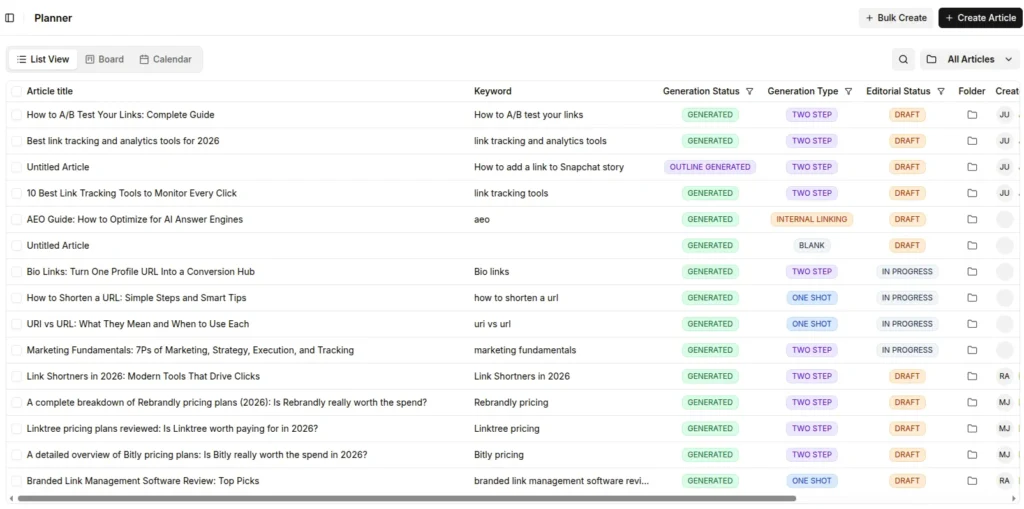
Contentpen is an AI content platform designed to help teams research, write, optimize, publish, and improve blog content with SEO and AI search visibility in mind.
At its core, the product focuses on long-form blog creation. Contentpen also includes keyword research, SERP analysis, topical clustering, SEO scoring, GEO scoring, automated internal and external linking, publishing integrations, website analytics, and AI visibility tracking.
In simple words, it is trying to solve a bigger problem than “write me a blog post.” It is built for people who want to turn content into a repeatable traffic system rather than a one-off writing task.
How I tested Contentpen for this review
To explore the platform in detail, I gave Contentpen simple writing tasks with topics like ‘how to summarize content’, ‘Best AI SEO tools in 2026’, and ‘Android 17 vs iOS 27’ to see its performance.
The writing workflow is divided into six main parts:
- Basics: Entering the main keyword and seeing a suitable title, target AI prompt, and secondary keywords for the phrase.
- Style: Selecting tone of voice and target audience settings, which the tool autofills from your set-up knowledge base.
- Formatting: Choosing the options of bold, italics, tables, quotes, lists, etc., for the content.
- Structure: Opting for an article size (small, medium, large, very large) and extra sections like key takeaways, conclusions, TOC, and FAQs.
- Media: Selecting the type of featured and in-article images required from the given styling options. Contentpen also has this new feature of attaching a relevant YouTube video for your content, so I kept it on for my testing.
- Linking: Choosing a suitable sitemap for internal links and turning on external linking (if required).
After these steps, you have to wait a while until you get a finalized piece of content.

After every output I received from the tool, I specifically judged the content based on:
- Readability: Is the content easy to read and understand?
- Search intent fulfillment: Was the blog fulfilling the search intent required to get to SERPs?
- Types of links placed: Did the tool place the links on relevant anchor texts? The accuracy of external links.
- Images and videos attached: What type of images did the tool create? Does the tool understand the context and provide visuals accordingly?
- Overall look and feel: How do I feel about the article? Is it publish-ready or does it still require detailed manual editing?
Based on these criteria, I was able to evaluate Contentpen in detail and conclude if it’s a suitable AI blog writer in 2026 or not.
Main Contentpen features that matter most
These were the features that stood out to me when I was testing Contentpen for different types of blogs and articles.
1. AI blog writing with built-in research
The useful part of Contentpen is not just that it can generate long-form content. It is that the writing workflow is tied to research inputs such as primary and secondary keywords, SERP analysis, competitor analysis, and content gaps.
That matters because many AI writing tools produce text first and leave you to reverse-engineer the SEO strategy afterward. Contentpen works the other way around. It builds the brief before the article.
From a practical standpoint, this gives users a few benefits:
- You can generate a full blog in one go or work from an outline first
- The draft is based on keyword and SERP inputs instead of a blank prompt
- The platform is designed around ranking and citability, not just readability
- You can keep everything inside one workflow instead of exporting notes from separate SEO tools
For content teams, that setup is a real time-saver. For solo users, it reduces the friction of turning a topic idea into a publishable brief and first draft.
That said, Contentpen can produce a solid structure and decent first version, but it will not magically create original expertise or a distinctive brand opinion on its own.
2. SEO and GEO scoring that goes beyond keyword stuffing
One of Contentpen’s more useful differentiators is that it does not frame optimization only around traditional SEO. It also includes GEO scoring, which is Contentpen’s way of helping users shape content for AI search and answer engines in addition to Google.
That matters because content teams increasingly want articles that can do two things at once:
- Rank in traditional search
- Surface or get cited in AI-generated answers
Inside the editor, Contentpen provides live SEO and GEO scoring plus one-click suggestions to improve weak areas. This makes the tool more actionable than platforms that simply hand over a generic “optimize this post” checklist.
What I like here is the workflow logic. Instead of publishing a draft and then cleaning up optimization later, Contentpen keeps scoring and improvement inside the writing process itself.
Why this feature matters most: If you are publishing at scale, optimization has to be fast and repeatable. A live scoring system is useful because it shortens the loop between draft, review, and publish.
3. Automated internal and external linking
This is one of the more practical features in the platform.
Contentpen can automatically add internal and external links based on context, relevance, and site structure. That might not sound glamorous compared to AI writing, but it solves a real workflow problem.
Internal linking is one of those SEO tasks that teams know they should do well, yet often handle inconsistently because it is repetitive and time-consuming.
Done properly, automated linking can help with:
- Stronger content relationships across your site
- Better crawl paths and page discovery
- More consistent linking hygiene across a growing blog
- Less manual cleanup before publishing
This feature is particularly useful for teams with a decent-sized content library. If your site already has dozens of blog posts, automated internal linking becomes much more valuable.
The caveat: Users still have to review automated link placement to ensure relevance, anchor text quality, and editorial flow in the content.
4. One-click publishing and scheduling
Contentpen includes direct publishing and scheduling, which makes the platform more operationally useful than tools that stop at draft generation.
According to the platform, users can publish directly to CMS platforms such as WordPress, Wix, Webflow, Shopify, and Ghost, which cuts out the usual copy-paste and formatting handoff between writing and publishing.
That matters more than it sounds. Once content teams start producing multiple posts a week, friction compounds quickly. If a platform can take you from draft to optimized article to scheduled publish in one place, it saves both time and tool switching.
In my opinion, this feature will appeal most to:
- Solo marketers who handle both writing and publishing
- Agencies managing multiple client content calendars
- Small teams trying to maintain publishing consistency without extra admin work
It is not the flashiest feature in the product, but it is one of the reasons Contentpen feels more like a workflow tool than a pure writer.
5. Keyword research, SERP analysis, and topical clustering
Contentpen also includes the planning layer that many AI writing tools skip.
Users can research keywords, review keyword metrics, analyze the SERP, identify gaps, and group related terms into topical clusters. That makes it easier to plan content around search intent.
This is valuable for two reasons.
First, it reduces the need to jump into another platform just to validate a topic before writing. Second, it nudges users toward building a content system around clusters and related pages, which is usually a smarter long-term strategy than chasing isolated keywords.
For newer content teams, this part of the platform may actually be more important than the AI writer itself. Strong research and content planning are often what separate traffic-producing blogs from blogs that publish often but go nowhere.
The limitation: I have personally tallied the keyword volume, difficulty, and CPC values from Contentpen with tools like Ahrefs and Semrush. I have found that Contentpen’s keyword data isn’t as accurate as dedicated SEO tools.
6. Website analytics and content opportunity tracking
This is where Contentpen becomes more interesting than a typical content generator.
On higher tiers, the platform connects to Google Search Console data and surfaces metrics such as clicks, impressions, CTR, average position, top pages, and top keywords. More importantly, it uses that data to flag content opportunities like:
- Quick wins: Pages that are close to ranking 1st on SERPs with targeted updates
- Content decay: Pages that are losing traffic and may need refreshing
- CTR gaps: Pages that rank but underperform in clicks
This matters because publishing content is only half the job. The bigger long-term win often comes from improving content that already has some traction.
Contentpen’s SEO opportunities layer is one of its strongest selling points because it ties content creation to actual performance management. The platform can help answer “which existing pages are worth fixing first?” before moving on to creating new pieces of content.
7. AI visibility tracking is a meaningful feature
Contentpen now also offers an AI visibility platform, which is separate from its core SEO content platform.
This side of the product is focused on monitoring how a brand appears across AI tools and search experiences, including metrics like share of voice, sentiment, average position, cited domains, and source gaps.
Depending on the plan, Contentpen can track visibility across tools such as ChatGPT, Grok, Google AI, Perplexity, Copilot, Gemini, and Claude.
I would treat this as a strategic add-on rather than the main reason to buy Contentpen. But for teams actively thinking about AI search visibility, it is a relevant feature because it moves the product beyond “write SEO blogs” into “measure how your brand is surfacing in AI answers.”
Contentpen pros and cons
We can state the following pros and cons for this tool, concluding based on everything discussed so far.
Pros:
- Combines writing, optimization, publishing, analytics, and content refresh workflows in one platform.
- Strong post-draft workflow with SEO scoring, GEO scoring, and content opportunity tracking.
- Automated internal and external linking solves a real SEO workflow bottleneck.
- Direct CMS publishing and scheduling reduce admin work.
- Useful for both new content and updating old posts.
- AI visibility tracking is a relevant addition for brands thinking about AI search.
Cons:
- Still needs human review for factual precision, originality, and brand nuance.
- Can have a learning curve if you only want a simple AI writing assistant.
- Some of the most valuable analytics and opportunity features are locked to higher tiers.
- Teams with mature SEO stacks may already have overlap with existing tools.
- AI output quality will vary by topic and prompt quality.
- Smaller blog sites may not get full value from every feature immediately.
How does Contentpen compare to other AI writing tools?
The following comparison table shows how Contentpen fares against other AI SEO tools in the space.
Who should use Contentpen?
Contentpen makes the most sense for users who want a content operations platform, not just an AI writer.
Contentpen is a good fit for:
- Content marketers publishing blogs regularly and trying to tie content production to measurable traffic growth.
- Freelancers who want a faster workflow for research, drafting, optimization, and publishing.
- Growth teams looking to capitalize on ranking opportunities and get detailed SEO audits.
- Small businesses that need an all-in-one content solution instead of juggling multiple tools at once.
- Agencies managing recurring content for multiple clients and needing approval-based workspaces and publishing to CMS and social platforms.
It may be less compelling for:
- Individuals who only need occasional blog drafts and already have a comfortable manual workflow.
- Brands that prioritize highly original editorial content over speed and workflow efficiency.
Contentpen pricing
Contentpen now splits its offering into two product tracks: An SEO platform and an AI visibility platform.
SEO platform pricing
| Plan | Price | Best for | Key inclusions |
| Starter | $39/month | Testing the platform | 10 articles/month, 1 workspace, 1 user, 30 AI images, CMS publishing, automated linking, real-time factual data, SERP analysis |
| Premium | $79/month | Solo marketers, freelancers, small businesses | 30 articles/month, 3 workspaces, 3 users, 100 AI images, plus bulk article generation, AI editing, knowledge base, analytics dashboard, content opportunities |
| Agency | $199/month | Agencies and larger teams | 100 articles/month, unlimited workspaces and users, 300 AI images, plus priority support, advanced reporting, and content opportunity features |
| Custom | Custom pricing | Brands with larger requirements | Tailored credits, users, workspaces, prompts, and integrations |
AEO platform pricing
| Plan | Price | Best for | Key inclusions |
| Essential | $39/month | Basic AI visibility tracking | 80 credits, 10 prompts, 2 AI models, weekly tracking |
| Growth | $99/month | Brands actively monitoring AI visibility | 250 credits, 30 prompts, 3 AI models, daily and weekly tracking, source gaps |
| Business | $199/month | Teams that want broader AI monitoring | 1,000 credits, unlimited prompts, 5+ AI models, unlimited competitors and workspaces |
| Custom | Custom pricing | Larger organizations | Tailored usage and integrations |
A few pricing notes are worth mentioning:
- Contentpen advertises a free 7-day trial.
- The annual pricing is attractive if you know you will use the platform consistently.
- The Premium SEO plan looks like the practical sweet spot for most marketers because that is where the analytics and content opportunity features become available.
- If you only want the core writing workflow, the ‘Starter’ plan is a lower-risk way to test the product before committing.
Final verdict: Is Contentpen worth it?
Yes, for anyone looking to grow their organic traffic.
Contentpen is one of the more practical AI content platforms I have seen for teams that want a single workflow for researching, writing, optimizing, publishing, tracking, and refreshing blog content.
Its biggest strength is not that it writes articles with AI. Plenty of tools do that. It is that it connects article creation to the rest of the SEO and GEO workflow.
That makes it a good fit for marketers and agencies who publish often and want a more systematic content engine. This makes Contentpen a solid option and one of the more capable SEO-focused AI content platforms in its category.
The caveat is straightforward: if all you need is a lightweight writing assistant, Contentpen may be more platform than you need. And if your content relies heavily on deep expertise or a distinctive editorial voice, you should still plan to edit the output carefully before publishing.

Happy
0 %

Sad
0 %

Excited
0 %

Sleepy
0 %

Angry
0 %

Surprise
0 %
 0
0
 0
0