
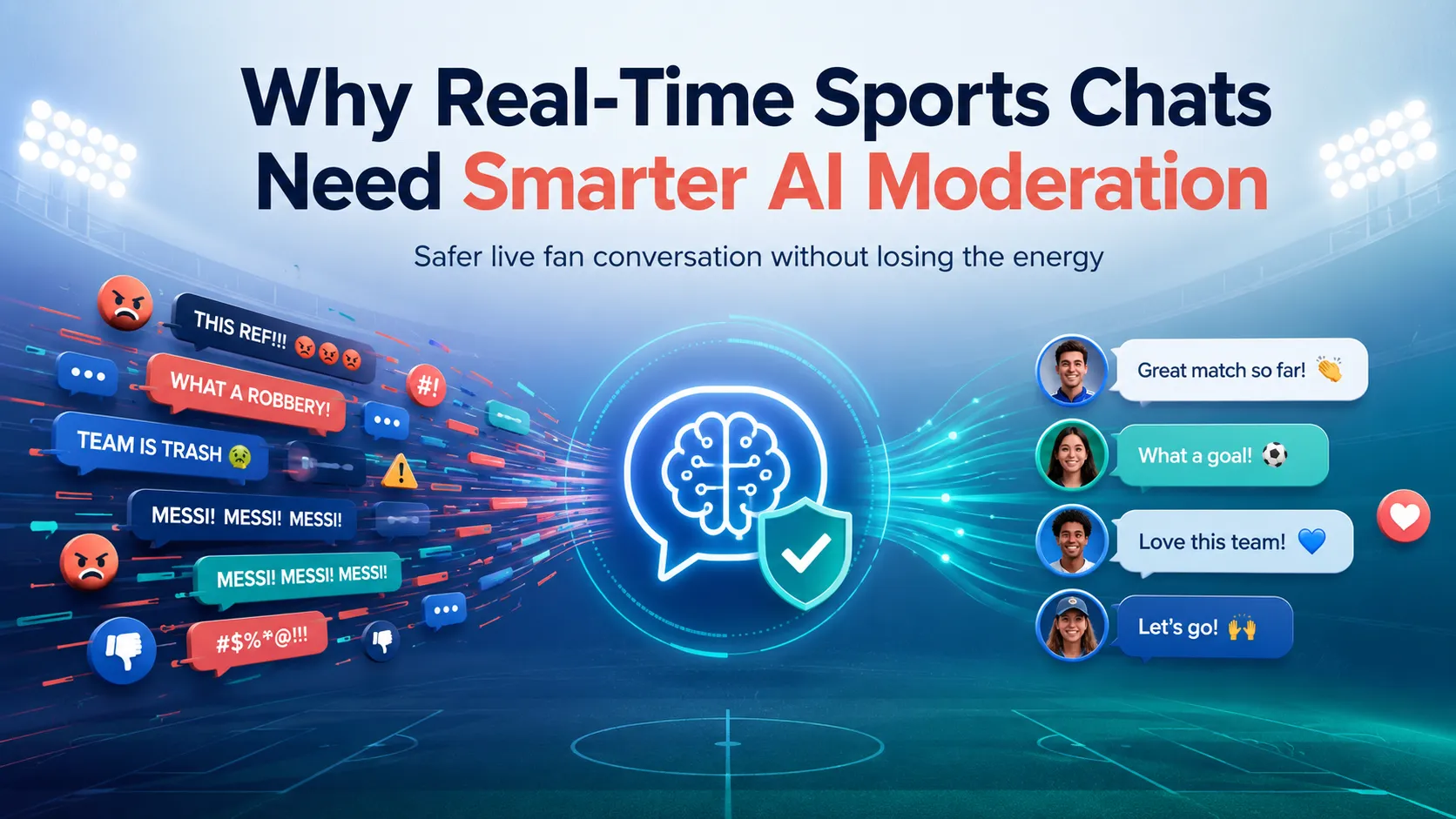
Why real-time sports chats need smarter AI moderation
Read Time:3 Minute, 13 Second
A live sports chat can look calm for twenty minutes, then change in one moment. A missed penalty, a bad call, a late goal, a red card, a stream delay. Suddenly the chat is full of jokes, anger, spam, copy-paste messages and arguments that move faster than any small moderation team can read.
This is the reason AI moderation for sports chats has become more than a safety add-on. Real-time fan spaces need protection, but they also need noise, humour, rivalry and emotion. If moderation removes too much, the room feels dead. If it removes too little, regular fans leave.
Keyword filters miss the point
Sports language is messy. Fans use slang, nicknames, chants, sarcasm, local references and exaggerated phrases that make sense only because of the match.
A simple keyword list can easily get confused. The same word might be harmless in one sentence and threatening in another. A joke about a referee may just be frustration. A targeted insult may be real abuse. A repeated link may be spam. A coded phrase may be worse than it looks.
The problem is not only the words. It is who said them, when they were posted, what happened in the game, and whether the message is part of a wider pattern.
Real-time chat creates real-time risk
Live sports chats are difficult because pressure arrives in bursts. The riskiest moments often come when the chat is busiest:
- controversial referee decisions;
- late goals or missed penalties;
- rivalry matches;
- player mistakes;
- ticket, stream or betting scams;
- sudden waves of repeated messages.
Human moderators still matter, especially for judgement and edge cases. But they cannot manually review every message during a traffic spike. A smarter AI layer can flag the obvious risks first, slow down repeat offenders, hide spam, and send harder cases to people who can review the context.
Smarter moderation protects the energy
The goal is not to make fans polite. That would miss the point of live sport.
A good sports chat should still feel alive. Fans should be able to complain, celebrate, tease, argue and react in the moment. The moderation layer should focus on behaviour that makes the space worse for normal users: harassment, scams, personal data, coordinated abuse, repeated spam and unsafe links.
That balance matters. If fans feel watched too heavily, they stop talking. If the chat becomes hostile or unreadable, they also stop talking. The useful middle is a room that still feels loud, but not broken.
Context is what makes AI useful
Smarter AI moderation is useful because it can look beyond one isolated word. It can consider repetition, timing, message similarity, links, account behaviour and previous flags.
It can also help separate normal fan intensity from harmful behaviour. That does not mean AI gets every decision right. Sarcasm, local slang and club rivalries can be difficult even for people. But AI can reduce the volume of obvious problems and give human moderators a clearer queue of cases that actually need attention.
For sports platforms, that means moderation becomes part of the product experience. It is not just a rulebook hidden behind the chat. It affects whether fans feel comfortable enough to keep posting.
Safe chats keep fans closer
A live chat that works well gives fans a reason to stay near the match, stream or app. They can react without leaving for a group chat, a social feed or a forum. The platform keeps more of the atmosphere around its own content.
That is why real-time sports chats need smarter moderation. The best version does not clean the room until it becomes silent. It keeps the room usable when the game gets emotional, crowded and unpredictable.
For sports platforms, that can be the difference between a chat that helps fan engagement and a chat that quietly teaches users to go somewhere else.

Happy
0 %

Sad
0 %

Excited
0 %

Sleepy
0 %

Angry
0 %

Surprise
0 %
 0
0
 0
0