
What Is a Residential Proxy and Why Does It Matter for Business in 2025?
Read Time:5 Minute, 56 Second
When a data center server requests a page from Amazon, Booking.com, or Google, those platforms know — within milliseconds — that it’s not a human. They fingerprint the IP range, check its ASN, cross-reference it against known hosting providers, and either block it, serve degraded content, or silently return wrong data. The request goes through. The result is garbage.
This is the core problem residential proxies solve.
The Difference Between a Residential IP and a Datacenter IP
Every device connected to the internet has an IP address. What matters for detection isn’t the address itself — it’s who assigned it.
Datacenter IPs are issued by cloud and hosting providers: AWS, Google Cloud, Hetzner, DigitalOcean. They’re fast, cheap, and concentrated in ranges that every major platform has already catalogued and flagged.
Residential IPs are issued by consumer ISPs — Comcast, BT, NTT, Deutsche Telekom — to ordinary home and mobile users. They’re geographically dispersed, tied to real devices, and statistically indistinguishable from normal consumer traffic.
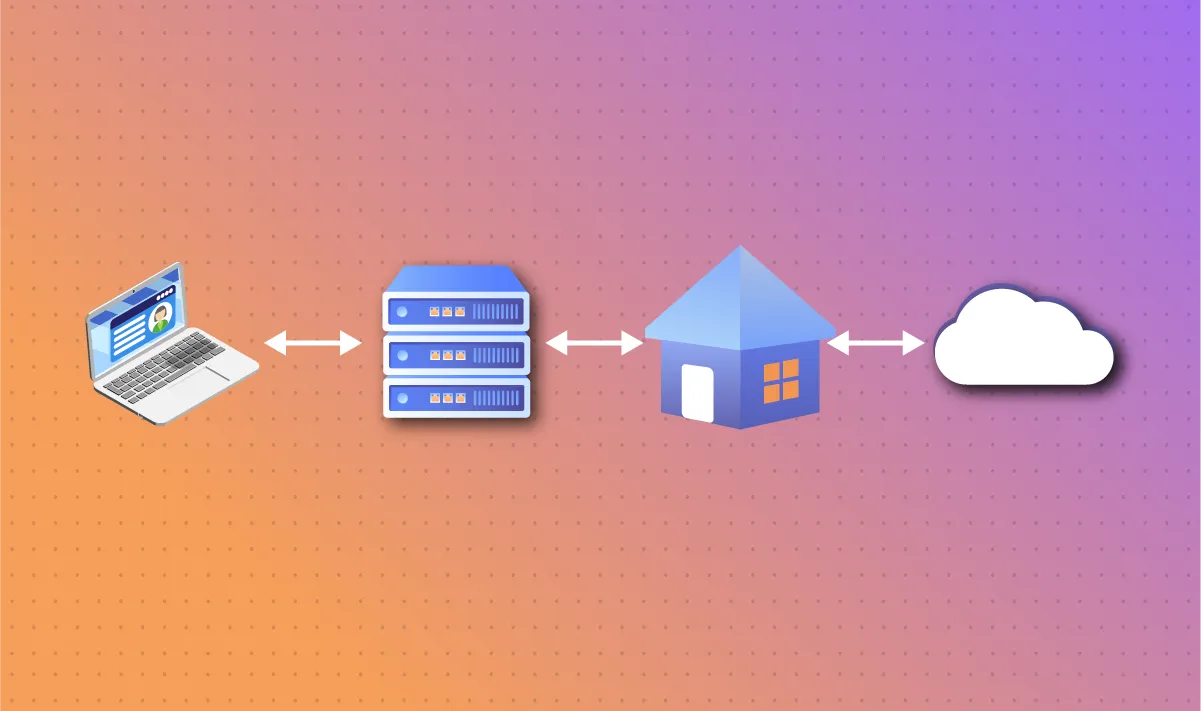
A residential proxy routes your requests through one of these consumer IPs. The target site sees a person in Chicago, Osaka, or Munich making a request — not a server in Frankfurt running a scraper.
How Residential Proxy Networks Are Built
Quality matters enormously here, and it starts with sourcing.
Legitimate residential proxy networks partner with app developers and service providers who compensate users for sharing a portion of their bandwidth — with explicit opt-in consent. The user knows their device is part of a proxy network. This is the ethical baseline; providers who don’t meet it expose their customers to legal and reputational risk.
The network pools millions of these IPs and exposes them through a single endpoint. Customers specify parameters — country, city, ASN, session type — and the network routes requests through matching nodes automatically.
Session modes split into two categories:
- Rotating — the IP changes per request or on a configurable interval. Each request appears to come from a different user, making volume detection nearly impossible.
- Sticky — the same IP is held for a defined window (minutes to hours). Required for any workflow involving authentication, multi-step forms, or session continuity.
Both modes should be available through the same endpoint, switchable per request.
Where Residential Proxies Are Actually Used
Price and market intelligence
Retailers, airlines, and SaaS companies show different prices to different audiences. The price a logged-out user in São Paulo sees differs from what a returning visitor in London sees — and both differ from what a known datacenter IP is shown (often a sanitized, bot-safe version that tells you nothing).
Accurate price monitoring requires requests that look like real customers in real locations. Residential proxies with city-level targeting make that possible at scale.
Search ranking verification
Google’s results vary by country, city, language setting, and device type. An SEO team running rank tracking from a single location is measuring a search result that almost none of their actual users see.
Rotating residential proxies let teams verify rankings from specific cities — checking what a user in Osaka sees versus a user in Berlin — with the IP diversity needed to avoid triggering rate limits or personalization effects.
Ad verification
Ad fraud costs the industry tens of billions annually. Verifying that campaigns actually serve the right creative, to the right audience, in the right geography, requires viewing placements from residential IPs in those locations. A datacenter IP gets either blocked or shown a generic fallback — useless for verification.
Account management at scale
Marketing agencies and growth teams managing multiple platform accounts face immediate bans if all activity originates from the same IP. Each account operating through a distinct, stable residential IP — held via sticky session — looks like a separate user to the platform’s detection systems.
Compliance and geo-restriction testing
Regulated industries need to verify that content, disclaimers, and pricing display correctly by jurisdiction. Software teams building geo-restricted features need to test them from IPs that actually geolocate correctly — not from a VPN that major platforms have already blacklisted.
What Separates a Good Provider from a Bad One
The residential proxy market has significant quality variance. These are the criteria that actually matter:
Pool depth and freshness. A large pool — 100M+ IPs — means lower reuse rates per target domain. Stale or over-used IPs accumulate blocks; a well-maintained network rotates supply continuously to keep success rates high.
Geographic granularity. Country-level targeting is table stakes. City-level and ASN-level targeting is what separates commodity providers from those useful for precision work.
Transparent success rates. Reputable providers publish or expose real-time success metrics. If a provider can’t tell you their request success rate on common targets, that’s a red flag.
Pricing structure. Pay-as-you-go with no traffic expiration is the most flexible model for variable workloads. Avoid providers who lock bandwidth to calendar months — unused traffic is pure waste.
Infrastructure ownership. Some providers resell another network’s capacity. That adds a layer between you and the network operators, which means slower support resolution and no control over underlying quality. Providers who run their own infrastructure — the peering, the rotation logic, the nodes — can fix problems directly.
The Practical Reality of Detection
Anti-bot systems have become significantly more sophisticated. IP reputation is only one signal among many: TLS fingerprints, HTTP/2 settings, header ordering, request timing patterns, and JavaScript execution behavior all factor into modern detection.
A residential IP alone doesn’t make a request undetectable. What it does is remove the single most obvious signal — the datacenter ASN — that triggers immediate hard blocks before any other analysis runs. For most targets, that’s sufficient. For hardened targets (major e-commerce platforms, streaming services, social networks), residential IPs need to be paired with proper browser fingerprinting, realistic request cadence, and session management.
The best residential proxy providers understand this and document it honestly. Anyone promising 100% success rates on all targets is either lying or hasn’t tested against serious protection systems.
Cost in 2025
Pricing has compressed over the past three years as the market matured and more providers entered. Current benchmarks:
| Volume | Price per GB |
|---|---|
| $20–99 top-up | ~$5.00 |
| $100–499 top-up | ~$4.00 |
| $500–999 top-up | ~$3.00 |
| $1,000–4,999 top-up | ~$2.00 |
| $5,000+ top-up | ~$1.00 |
The key variable is whether unused traffic rolls over. Month-based allocations penalize variable workloads. Balance-based models — where you top up once and spend down at any pace — suit most business use cases better.
The Bottom Line
Residential proxies are not a workaround or a hack. They are the correct tool for any task that requires your requests to be treated as legitimate consumer traffic — accurate data collection, geo-targeted verification, account management, and market intelligence all fall into this category.
The underlying principle is straightforward: if the accuracy of your data depends on how a target platform responds to your IP, you need IPs that platforms treat the same way they treat real users. That means residential.
The business case in 2025 is not “should we use residential proxies” but “which provider’s network quality, geographic coverage, and pricing model fits our workload.”

Happy
0 %

Sad
0 %

Excited
0 %

Sleepy
0 %

Angry
0 %

Surprise
0 %
 0
0
 0
0