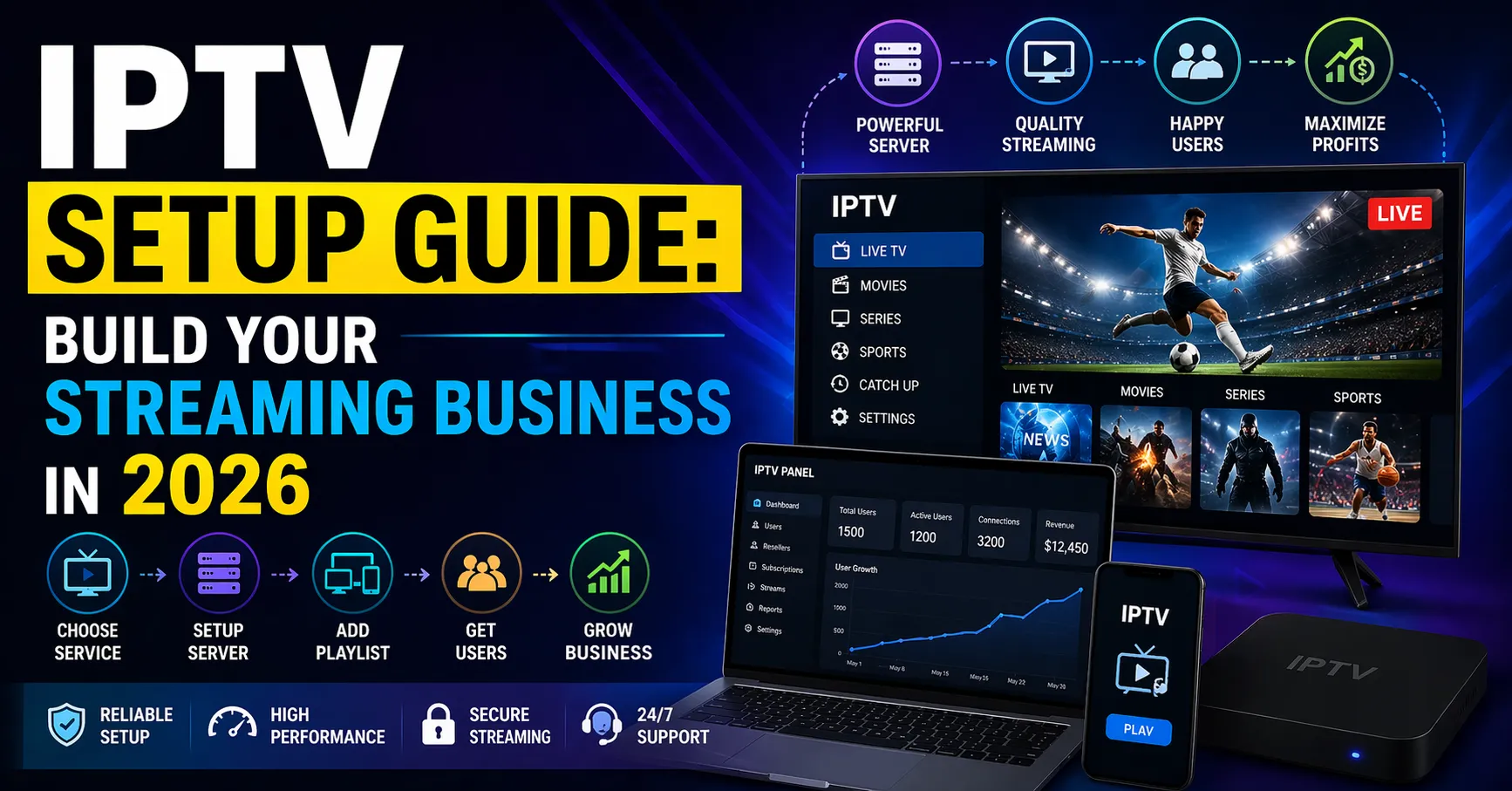
IPTV Setup Guide: Build Your Streaming Business in 2026
Read Time:8 Minute, 13 Second
Every week, thousands of people across the UK sit down to watch their favourite shows — only to be greeted by a spinning buffer wheel, a frozen screen, or a service that simply stops working at the worst possible moment. If that sounds familiar, you are not alone.
The problem is not always a slow internet connection. Often, it comes down to the platform itself — how it is built, who manages it, and whether the technology behind it was designed to scale.
This IPTV setup guide exists to cut through that confusion. Whether you are a viewer tired of unreliable streaming, a small business owner exploring digital opportunities, or an entrepreneur thinking about entering the streaming market — this article explains everything you need to know clearly and honestly.
Autven Private Limited has spent years helping businesses across the UK and Europe build stable, professional-grade streaming platforms. What follows draws on that experience, combined with what is actually happening in the IPTV industry right now.
What Makes IPTV Different in 2026?
Not long ago, if you wanted to watch television, you waited for a broadcaster to push content to your screen at a scheduled time. Cable gave you more choices. Satellite gave you even more. But you were still at the mercy of someone else’s schedule.
IPTV — Internet Protocol Television — flipped that entirely.
Instead of receiving a signal from a satellite dish or cable box, IPTV delivers content directly through your internet connection. That single shift changed everything: on-demand libraries, live channels from dozens of countries, and content that travels with you on any device.
In 2026, the technology has matured considerably. Modern IPTV services now support 4K streaming, multi-device access, electronic programme guides (EPGs), and catch-up features that were considered premium luxuries just a few years ago.
According to a 2024 report by Grand View Research, the global IPTV market was valued at over $67 billion and continues to grow at a compound annual rate of more than 7%. That growth is not slowing — it is accelerating, particularly across Western Europe.
The shift is also structural. Broadband infrastructure in the UK has improved dramatically, with Ofcom’s 2024 Connected Nations report confirming that over 70% of UK premises now have access to superfast broadband. That foundation is exactly what IPTV needs to thrive.
How Smart IPTV Works — A Simple Explanation
The phrase gets used a lot, but what does Smart IPTV actually mean in practice?
At its most basic level, Smart IPTV refers to IPTV applications designed to run on smart televisions — Samsung, LG, Android TV, and similar platforms. Rather than needing a dedicated set-top box, viewers simply install an app on a device they already own.
Here is how the process works, without any jargon:
- A content provider or reseller holds a playlist of channels and video-on-demand content
- That playlist is accessed through a URL or login credentials shared with the viewer
- The Smart IPTV app on the television reads that playlist and displays the content in a clean, organised interface
- The viewer selects what they want to watch, and the stream is delivered in real time over their internet connection
The experience, when done properly, is indistinguishable from traditional broadcast television — except the viewer is in complete control of what plays, when it plays, and on which screen.
What makes Smart IPTV particularly appealing from a business perspective is low hardware dependency. There is no expensive box to ship, no installation engineer to send, and no contract tied to physical infrastructure.
How to Start as an IPTV Reseller
The business model behind IPTV reselling is straightforward once you understand it — and surprisingly accessible for people with no technical background.
A reseller purchases streaming credits or panel access from a larger provider (often called a wholesaler or panel provider). Those credits represent a set number of active subscriptions. The reseller then sells individual subscriptions to their own customers at a higher price, keeping the margin as profit.
Think of it like a mobile network virtual operator. You are not building the infrastructure — you are distributing access to it under your own brand.
Here is what a basic reseller relationship typically looks like:
- Panel access: A back-end dashboard where you create and manage customer accounts
- Credit system: You buy credits in bulk; each active subscription uses a certain number of credits per month
- Branding: Many panel providers allow white-label setups, meaning your customers see your brand name, not the wholesaler’s
- Support responsibility: As the reseller, you handle customer queries — the panel provider handles the technical back-end
The entry investment is relatively modest compared to most digital businesses. What separates successful resellers from those who struggle is the quality of their provider, the reliability of the streams, and how professionally they handle customer relationships.
Why United Kingdom IPTV Is Growing Fast
The demand for United Kingdom IPTV has grown for reasons that are not difficult to understand.
British viewers have traditionally had strong appetites for live sport, drama, and international content. The problem with traditional broadcast platforms — even streaming giants like Netflix and Disney+ — is that they do not always serve niche demands. International communities living in the UK, for example, often want content from their home countries that mainstream platforms simply do not carry.
IPTV fills that gap. A Polish family in Manchester, a South Asian household in Leicester, or a football fan who follows a non-televised league — all of them represent audiences that IPTV can serve where conventional platforms cannot.
Beyond niche audiences, there is a broader trend toward cord-cutting. YouGov research from 2024 indicated that a growing segment of UK adults under 45 no longer subscribe to traditional pay-TV services, preferring internet-based alternatives instead.
The result is a market that is fragmented, hungry for alternatives, and increasingly comfortable with IPTV as a concept. For businesses willing to serve that market responsibly and professionally, the timing is genuinely strong.
How to Build an IPTV Reseller UK Business
Building a credible IPTV reseller UK operation involves more than simply buying a panel and pointing people toward a payment link. The businesses that succeed think about this as a proper service business — with customer experience at the centre.
Here is a practical starting framework:
Step 1 — Choose your provider carefully Not all panel providers are equal. Look for stability, uptime guarantees, channel reliability, and whether the provider offers genuine technical support. A weekend outage during a major live sporting event will cost you customers quickly.
Step 2 — Define your niche Are you targeting UK-based expat communities? Sports fans? Budget-conscious families? Having a clear audience helps you tailor your offering and makes marketing far more effective.
Step 3 — Set up professional customer touchpoints This means a proper website, a clear pricing page, and a support channel — even if it is just a WhatsApp number or an email address. Professionalism builds trust in a market where many providers look and behave poorly.
Step 4 — Price with margin and sustainability in mind Underpricing might bring customers quickly, but it leaves you no room to absorb costs when things go wrong. Price fairly, offer genuine value, and resist the temptation to compete purely on cost.
Step 5 — Think about compliance from day one This is not optional. Operating an IPTV reseller business in the UK requires careful attention to what content you are distributing and under what licensing conditions. More on this below.
Common Problems — and How to Solve Them
Even well-run IPTV businesses encounter friction. Here are the most common issues, along with honest guidance on addressing them:
- Buffering and stream interruptions Usually caused by server-side overload or the customer’s own internet connection being insufficient. Best approach: test your provider’s streams during peak hours before committing, and provide customers with clear minimum internet speed requirements upfront.
- Poor service quality from wholesale providers This is where provider selection matters enormously. Switching providers mid-business is painful and risks customer churn. Vet your provider with a trial period before scaling any customer base.
- Legal and licensing concerns This is the most important point in this entire guide. IPTV is a legal technology — but the content distributed through some reseller networks is not always properly licensed. In the UK, the Intellectual Property Office and enforcement bodies have been actively pursuing operators distributing unlicensed content. A compliant, sustainable business distributes only properly licensed material. Autven works exclusively within legal frameworks and advises all partners to do the same.
- Customer trust In a market with many unreliable operators, trust is genuinely a competitive advantage. Clear communication, honest uptime expectations, and responsive support will retain customers far more effectively than discounts.
- GDPR and data privacy If you are collecting customer data — names, email addresses, payment information — you are subject to UK GDPR obligations. Use compliant payment processors, store data securely, and have a clear privacy policy in place. Autven builds GDPR-compliant systems for clients across the UK and Europe, and these are not afterthoughts but design fundamentals.
Conclusion
The IPTV industry in the UK is not a passing trend. It is a maturing market with real commercial opportunity for businesses willing to approach it seriously, legally, and with genuine customer focus.
This IPTV setup guide has walked through the core concepts — from how Smart IPTV works at a basic level, to the reseller business model, to the practical steps of building something sustainable in the UK market. None of it requires a technical background. What it does require is the right provider, a professional approach, and a commitment to operating compliantly.
Autven Private Limited supports businesses across the UK and Europe at every stage of this journey — from initial setup and platform development to ongoing technical support and compliance guidance. If this guide has helped clarify your thinking, the next step is simply a conversation.

Happy
0 %

Sad
0 %

Excited
0 %

Sleepy
0 %

Angry
0 %

Surprise
0 %
 0
0
 0
0