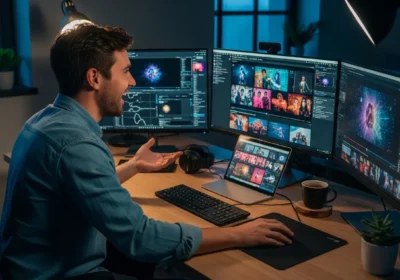

What Does a Curved Monitors Do?
Read Time:5 Minute, 25 Second
What Does a Curved Monitors Do? Unveiling the Benefits and Features
In recent years, curved monitors have gained significant popularity among gamers, professionals, and everyday users alike. But what exactly does a curved monitor do, and is it worth the investment? In this article, we’ll explore the benefits, features, and potential drawbacks of curved monitors to help you decide if they’re the right choice for you.
Whether you’re a gamer seeking an immersive experience, a professional aiming for enhanced productivity, or just a tech enthusiast, a curved monitor might just change the way you view your screen. For those looking for a comprehensive list of the best options available, you can explore some of the best curved monitors for a deeper dive.
1. Understanding Curved Monitors: What Are They?
Curved monitors feature screens that bend inward, mimicking the natural curvature of the human eye. This design enhances viewing comfort and creates a more immersive experience compared to traditional flat screens. The curve is usually subtle, with the most common curvatures being 1800R, 2300R, and 3000R — the lower the number, the more pronounced the curve.
The idea behind this design is to reduce eye strain and improve depth perception by keeping the edges of the screen within your peripheral vision. This is particularly useful for ultra-wide monitors, where flat panels might cause distortion or require more eye movement.
2. Enhanced Immersion and Viewing Experience
One of the most significant benefits of curved monitors is the sense of immersion they provide. By wrapping the screen around your field of vision, curved monitors make you feel as if you’re part of the action — whether you’re exploring vast game worlds or watching a blockbuster movie.
This effect is especially noticeable in gaming, where the combination of a curved monitor and a wide field of view can transform the experience. Games feel more lifelike, and the sense of depth becomes more pronounced, making it easier to spot details at the edges of the screen without straining your eyes.
For more insights into how curved monitors can enhance your gaming and everyday experiences, check out WiredTech.
3. Reduced Eye Strain and Improved Comfort
Staring at a flat monitor for long hours can cause eye strain due to the constant focus adjustments needed for objects at different distances across the screen. Curved monitors, however, minimize these adjustments by maintaining a consistent focal distance.
This design aligns more naturally with the way our eyes perceive the world, reducing the amount of eye movement needed to view the entire screen. As a result, users experience less fatigue, making curved monitors a solid choice for professionals who spend extended hours in front of their screens.
4. Enhanced Field of View and Depth Perception
The curvature of these monitors not only enhances immersion but also expands your field of view. By bending the screen’s edges slightly toward you, curved monitors reduce distortion and ensure that all parts of the screen are equidistant from your eyes.
This design significantly improves depth perception, allowing users to better gauge distances and sizes of objects on the screen. For gamers, this can be the difference between spotting an enemy in the distance or missing out on crucial details.
5. Better Contrast and Reduced Glare
Curved monitors can also enhance contrast levels by directing light from all parts of the screen more directly towards your eyes. This effect is particularly noticeable in darker scenes, where the curvature helps prevent light from dispersing.
Additionally, curved screens minimize glare by reflecting ambient light away from your eyes instead of directly into them. This is a significant advantage if you work or game in a well-lit room, as it ensures a clearer and more comfortable viewing experience.
6. Productivity Boost for Professionals
For professionals dealing with large spreadsheets, multiple documents, or design software, curved ultra-wide monitors can be a game-changer. The extended screen real estate allows you to have multiple windows open side-by-side without the need for a dual-monitor setup.
The immersive nature of curved monitors also helps you focus better, making it easier to switch between tasks without getting distracted. Many users report increased productivity and a smoother workflow when using curved screens, especially in fields like video editing, graphic design, and financial analysis.
7. Curved vs. Flat Monitors: Key Differences
While curved monitors offer numerous benefits, they aren’t without drawbacks. Here’s a quick comparison:
| Feature | Curved Monitors | Flat Monitors |
|---|---|---|
| Immersion | Highly immersive, especially for gaming | Less immersive |
| Eye Comfort | Reduced strain for prolonged use | More eye movement required |
| Glare Reduction | Minimizes glare from ambient lighting | More prone to glare |
| Desk Space | Requires more space due to the curved design | Compact and space-efficient |
| Cost | Generally more expensive | Typically more affordable |
Choosing between curved and flat monitors depends on your use case. If you’re a gamer or a professional needing extensive screen space, a curved monitor is a worthy investment. On the other hand, if you’re on a budget or have limited desk space, a flat monitor might suffice.
8. Drawbacks of Curved Monitors
Despite their advantages, curved monitors do have some downsides:
- Price: Curved monitors tend to be pricier than their flat counterparts.
- Wall Mounting: Most curved monitors aren’t ideal for wall mounting due to their shape.
- Optimal Viewing Position: To get the best experience, you need to sit directly in front of a curved monitor. Off-angle viewing can cause distortion.
These factors might not be deal-breakers, but they’re worth considering before making a purchase.
Is a Curved Monitor Worth It?
Ultimately, the value of a curved monitor comes down to personal preference and usage. Gamers, content creators, and professionals who spend long hours on their screens can benefit significantly from the enhanced immersion, reduced eye strain, and wider field of view.
However, if you primarily use your monitor for basic tasks like web browsing and document editing, the benefits might not justify the cost. In such cases, investing in a high-quality flat monitor could be more practical.
If you’re leaning towards getting a curved monitor, you can explore some top options on WiredTech.
Conclusion
Curved monitors offer a blend of comfort, immersion, and enhanced viewing experience that flat monitors struggle to match. Their design aligns better with human vision, making them an excellent choice for gamers, professionals, and anyone who values a more natural and immersive viewing experience.
Before making a purchase, consider your specific needs, desk space, and budget. With the right choice, a curved monitor can significantly enhance your productivity and entertainment experiences.

Happy
0 %

Sad
0 %

Excited
0 %

Sleepy
0 %

Angry
0 %

Surprise
0 %
 0
0
 0
0