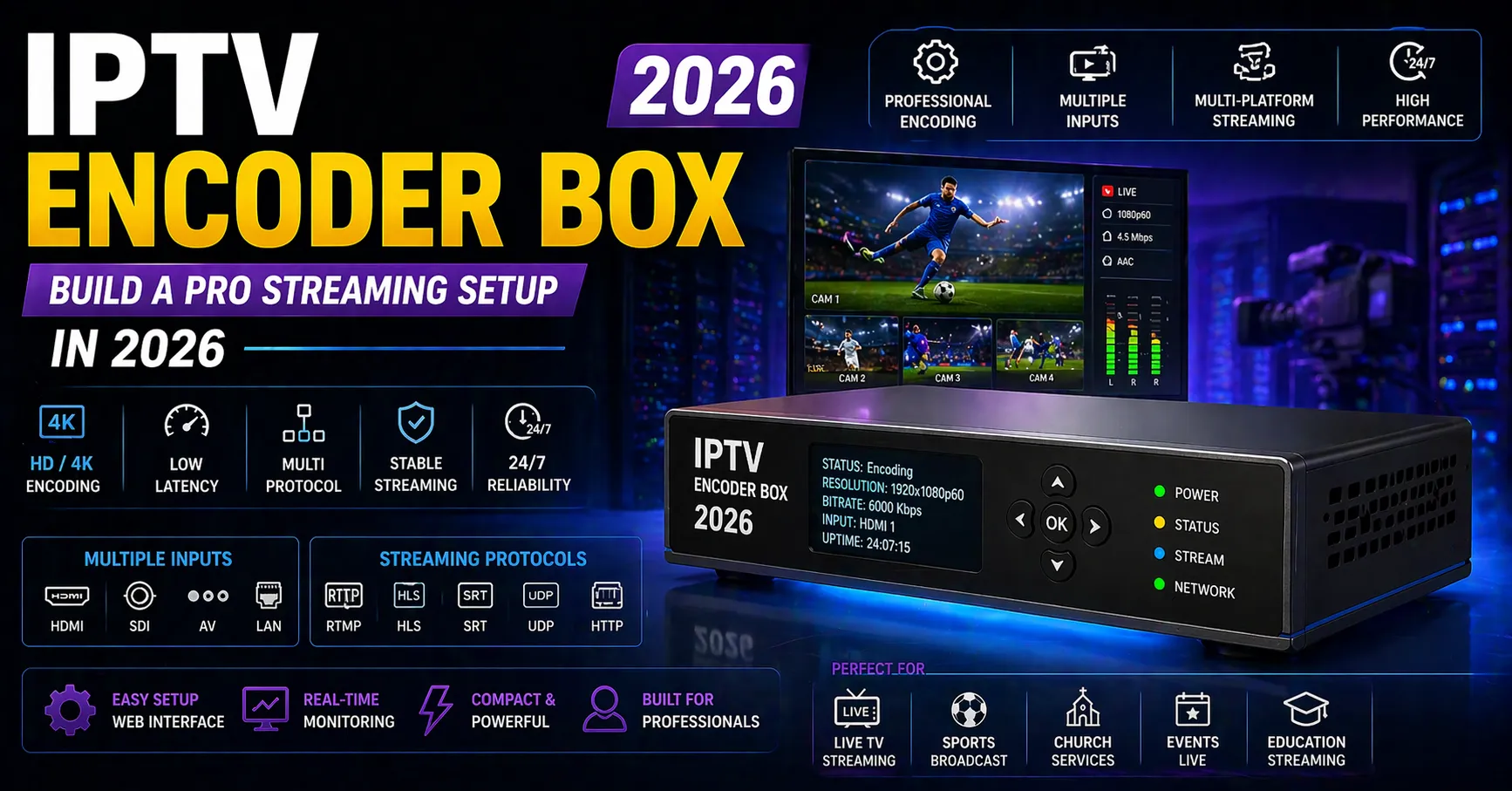
IPTV Encoder Box 2026: Build a Pro Streaming Setup in 2026
Read Time:8 Minute, 14 Second
You scheduled a live stream. Everything looked ready. Then — three seconds in — the picture froze, the audio dropped, and your viewers left. Sound familiar?
This is the reality for thousands of businesses, broadcasters, and content creators who are still relying on outdated or poorly configured streaming setups. The frustrating part? The solution is simpler than most people realise. It often starts with one piece of hardware that doesn’t get nearly enough attention: the IPTV encoder box.
This article is written for business owners, content providers, and entrepreneurs who want to understand how IPTV streaming actually works in 2026 — without wading through technical manuals. Whether you’re planning to launch a channel, build a streaming product, or start a reseller business, this guide will walk you through everything in plain English.
Autven Private Limited has been helping businesses across the UK and Europe build reliable streaming systems, and what we’ve learned from working across dozens of projects is this: the right encoder makes the difference between a service people trust and one they abandon.
What Is an IPTV Encoder Box and Why Does It Matter?
Think of an IPTV encoder box as the translator between your live video source — a camera, a satellite feed, a broadcast signal — and the internet. Without it, raw video footage can’t travel across networks in a format that viewers’ devices can receive and play smoothly.
Traditional broadcast TV sends signals through cables or satellites. IPTV does something different. It converts video into digital data packets and delivers them over an internet connection, directly to any compatible screen — a phone, a smart TV, a laptop, anywhere.
The encoder is the first and most critical step in that chain. It captures the source video, compresses it, and sends it out in a streaming-ready format like H.264 or H.265. Get this part right, and everything downstream becomes much more manageable. Get it wrong, and no amount of expensive servers or fast broadband will save your stream quality.
According to Ofcom’s 2024 Connected Nations Report, over 96% of UK premises now have access to superfast broadband — meaning the infrastructure to support high-quality IPTV streaming is already there for most businesses. The bottleneck is rarely the connection. It’s usually the encoding.
How Smart IPTV Works Today — A Plain-English Breakdown
Here’s where things get interesting. Smart IPTV isn’t just a catchy phrase — it refers to an ecosystem of apps, middleware, and devices that work together to deliver content intelligently based on who’s watching, on what device, and at what connection speed.
A modern smart IPTV setup typically involves four layers:
The source — your live feed, a pre-recorded library, or a broadcast signal coming in via HDMI or SDI.
The encoder — the IPTV encoder box, which compresses and packages the video into streamable data.
The middleware — software that manages subscriptions, user authentication, channel guides, and on-demand libraries.
The player — the app or device your end-user actually watches on, whether that’s a dedicated set-top box, a Smart TV app, or a mobile application.
What’s changed in 2026 is the level of integration between these layers. Modern encoder boxes now come with built-in cloud connectivity, automatic bitrate adjustment, and remote management dashboards. A small business can now manage a professional streaming operation from a single dashboard without needing a dedicated technical team on site.
Why United Kingdom IPTV Demand Is Accelerating
The numbers tell a clear story. Statista data from 2024 shows that the number of IPTV and video streaming subscribers in Europe is expected to surpass 200 million by 2027, with the United Kingdom representing one of the fastest-growing individual markets on the continent.
United Kingdom IPTV adoption isn’t happening by accident. Several factors are converging at once.
First, traditional pay-TV subscriptions are declining. Viewers are cutting cable packages and looking for more flexible, lower-cost alternatives. Second, UK businesses — from gyms and hotels to sports clubs and media companies — are realising that owning their own content distribution channel is both achievable and commercially valuable. Third, the hardware required to run a proper IPTV operation has become dramatically more affordable and accessible over the last three years.
There’s also a cultural shift at play. UK audiences now expect to watch content on their terms — paused, rewound, restarted, and available across multiple devices. That expectation has created a serious demand for IPTV infrastructure that can actually deliver on it.
The IPTV Reseller Model — What It Is and How It Works
Not everyone building an IPTV business needs to build the entire technical stack themselves. That’s where the IPTV reseller model becomes genuinely useful.
As a reseller, you’re essentially acting as a distribution partner. You purchase streaming capacity, content packages, or platform access from an established provider, then package and sell it to your own customers under your own brand. The technical infrastructure is handled upstream — your job is the customer relationship, the branding, and the business development.
It’s a model that works particularly well for:
- Digital agencies looking to add a recurring revenue stream
- Telecoms or broadband providers wanting to bundle services
- Entrepreneurs entering the streaming space without years of technical experience
- Existing media businesses that want to expand their distribution
The economics are straightforward. Your margin is the difference between your wholesale cost and what your customers pay. The key to making it work is finding a reliable upstream provider with the right licensing in place — because the legal side of IPTV is something that cannot be overlooked.
Building an IPTV Reseller UK Business — Step by Step
If you’re thinking seriously about becoming an IPTV reseller UK, here’s a practical framework to start with.
Step 1 — Understand what you’re selling. Are you reselling live TV channels, on-demand content, sports packages, or a combination? Your answer shapes every decision that follows, including the encoder hardware you’ll need and the middleware that suits your use case.
Step 2 — Choose your technical partner carefully. Your upstream provider’s reliability becomes your reputation. Ask about their uptime guarantees, support response times, and whether their content licensing covers the territories you’re selling into.
Step 3 — Sort the legal foundations early. In the UK, distributing broadcast content requires proper licensing. Selling unlicensed content — even unknowingly — carries real legal risk. Work with providers who can demonstrate their compliance, and consult a media law specialist if you’re unsure. GDPR compliance for customer data is equally non-negotiable.
Step 4 — Configure your encoder setup. Even as a reseller, understanding how the IPTV encoder box fits into your service helps you troubleshoot customer complaints intelligently. You don’t need to build one from scratch, but knowing how encoding quality affects viewer experience makes you a more credible operator.
Step 5 — Build a simple but professional customer-facing experience. Branding, billing, and support channels matter as much as the technical quality of your stream. Customers who can easily get help when something goes wrong are customers who stay.
Step 6 — Test before you launch. Run your setup across multiple devices, connection speeds, and locations before you go live with paying customers. What works on your office Wi-Fi might behave very differently on a 4G connection in a rural area.
Common Problems and How to Solve Them
Every IPTV operation, whether brand new or well established, runs into the same handful of challenges. Here’s an honest look at them and what actually helps.
- Buffering and freezing — Almost always an encoding or bandwidth issue. An underpowered encoder box trying to compress too many channels at once will produce unstable streams. The fix is usually right-sizing your hardware to your actual output requirements, and ensuring your upstream bandwidth has enough headroom.
- Poor picture quality — Often caused by incorrect bitrate settings. H.265 encoding at the right bitrate can deliver excellent quality at significantly lower bandwidth than older formats. Most modern encoder boxes support this, but many operators never configure it properly.
- Legal grey areas — This is the most serious issue in the IPTV industry. Distributing unlicensed content is illegal in the UK, full stop. Any credible provider — including Autven — operates only within properly licensed frameworks, and any reseller partner should insist on the same.
- Customer trust — New IPTV businesses often struggle with credibility, particularly because the market has been damaged by fly-by-night unlicensed services. Clear branding, transparent pricing, reliable uptime, and a real support channel go further than any marketing spend in building lasting trust.
- GDPR and data handling — Collecting subscriber data means accepting responsibility for protecting it. Ensure any platform or middleware you use is built with GDPR compliance in mind — especially if your customers are based in the UK or Europe.
Autven works with clients from the earliest planning stages to help them navigate exactly these issues, whether they’re configuring encoder hardware, selecting middleware, or simply trying to understand what questions to ask a prospective upstream partner.
Conclusion
The IPTV encoder box might not be the most glamorous piece of technology, but it’s the foundation on which every reliable streaming service is built. Get it right, and everything else — quality, consistency, customer trust — becomes significantly easier to achieve.
The UK market is growing, the business models are accessible, and the technical barriers are lower than they’ve ever been. But the difference between a streaming service that succeeds and one that quietly disappears usually comes down to how seriously the operator takes the fundamentals: good encoding, legal compliance, proper data handling, and a genuine commitment to the customer experience.
Autven Private Limited works with businesses across the UK and Europe to get those fundamentals right — from hardware selection and platform setup to ongoing technical support. If you’re building something in this space, the conversation is worth having sooner rather than later.
Author Bio
[Hayden] is a Streaming Solutions Specialist at Autven Private Limited, helping businesses build reliable digital platforms, apps, and streaming systems across the UK and Europe.

Happy
0 %

Sad
0 %

Excited
0 %

Sleepy
0 %

Angry
0 %

Surprise
0 %
 0
0
 0
0